
The UN and the Gaza Information War: When Information Becomes More Dangerous Than Missiles
Has the Israel-Hamas war exposed a deeper crisis in global information systems? This analysis examines allegations that disputed narratives were amplified by international institutions, raising questions about verification, credibility and the role of information as a weapon in modern warfare.
- World News
- 4 min read

;'%3e%3cpath%20d='m8,15.99c4.41,0,7.99-3.58,7.99-7.99S12.41,0,8,0,0,3.59,0,8s3.58,7.99,7.99,7.99Z'%20style='stroke:%23fff;%20stroke-miterlimit:10;%20stroke-width:.02px;'/%3e%3cpath%20d='m3.08,3.37l3.82,5.11-3.84,4.15h.87l3.37-3.64,2.72,3.64h2.94l-4.04-5.39,3.58-3.87h-.86l-3.1,3.35-2.5-3.35h-2.94Zm1.27.64h1.35l5.97,7.99h-1.35l-5.97-7.99Z'%20style='fill:%23fff;'/%3e%3c/g%3e%3c/svg%3e)


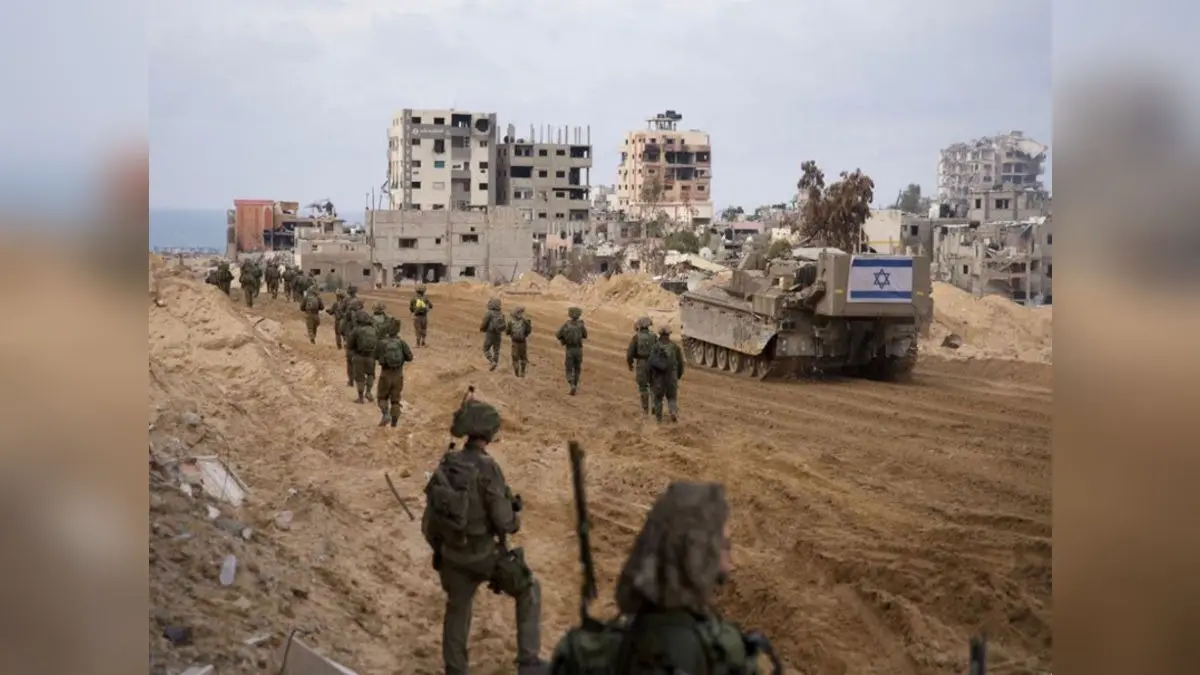
The Israel Hamas war has exposed a reality that many policymakers and international institutions have been reluctant to confront in modern warfare, information can be as consequential as military force itself.
Wars are no longer fought only with missiles, tanks and soldiers. They are fought through casualty figures, humanitarian narratives, viral imagery and institutional reports that shape global opinion, diplomatic pressure and international policy within hours.
Since the October 7 Hamas attacks, in which approximately 1,200 people were killed and more than 250 people were taken hostage according to Israeli authorities, the conflict has evolved into one of the most intense information wars of the modern era.
At the centre of this debate is a question that the international community can no longer afford to ignore what happens when information originating from a terrorist organisation is repeatedly transmitted through trusted international institutions and ultimately accepted as fact?
Advertisement
A recent report, Laundering Propaganda: How UN Actors Manipulated Information in the Gaza War (2023–2025), presents a troubling conclusion. It argues that parts of the UN system functioned not as neutral arbiters of information but as amplifiers of Hamas originated narratives during the Gaza war. Through repeated citation, redistribution and institutional endorsement, disputed claims were transformed into accepted international narratives before they were properly scrutinised.
The report describes this process as "data laundering" the transformation of contested information into institutional truth through repetition by organisations whose credibility shields claims from rigorous examination. It cites disputed casualty reporting, the Al-Ahli hospital explosion and aid delivery statistics as examples of this phenomenon.
Advertisement
Whether one agrees with every conclusion of the report or not, its broader warning deserves attention. The danger is not simply that Hamas produces propaganda. The greater danger is that respected international institutions can transform that propaganda into accepted international narratives.
Within days of the attacks, digital platforms were flooded with competing narratives, disputed casualty claims and emotionally charged statistics that rapidly shaped international perceptions of the war. One of the clearest examples came after the explosion at the Al-Ahli hospital compound in Gaza in October 2023. Initial reports alleging an Israeli airstrike that killed hundreds of civilians spread globally within minutes. Governments reacted. International organisations issued statements. Demonstrations erupted across multiple countries.
Yet subsequent intelligence assessments from several Western governments and independent open-source analysts cast significant doubt on the original allegations, with many concluding that the blast was more likely caused by a failed rocket launched from within Gaza. Casualty estimates were also revised substantially downward. By then, however, the political, diplomatic and reputational damage had already been done.
The Al-Ahli episode was not an isolated incident. Throughout the war, disputed casualty figures, contested aid delivery narratives, famine projections and humanitarian allegations repeatedly shaped international discourse before independent verification could take place. Several of the most influential claims of the war were later revised, disputed or significantly qualified yet the corrections received only a fraction of the visibility of the original allegations.
That imbalance matters because information itself has become a strategic weapon. Modern conflicts are increasingly shaped by narrative dominance as much as military capability, influencing diplomacy, legal proceedings, public opinion and international relations far beyond the battlefield.
Hamas has long understood this reality. Operating from within densely populated civilian environments, it has developed a model in which military confrontation and information warfare are inseparable. Civilian suffering rapidly becomes global political content, regardless of the complexity of the underlying circumstances.
That reality places enormous responsibility on international institutions, humanitarian agencies and global media organisations. Yet throughout the war, information originating from Hamas controlled sources was repeatedly cited and amplified by institutions whose credibility gave those claims global reach and legitimacy.
If the report's findings are correct, this was not merely a reporting failure. It was a failure of institutional responsibility on a global scale. None of this diminishes the suffering endured by civilians in Gaza or the trauma inflicted by the October 7 attacks and the continuing hostage crisis. Humanitarian suffering deserves documentation and attention. But humanitarian concern cannot come at the expense of factual integrity.
If international institutions become conduits for disputed information rather than guardians of verified information, public trust will inevitably erode. And once trust in those institutions begins to collapse, rebuilding it becomes extraordinarily difficult. The debate is not about whether humanitarian suffering should be documented. It is about whether accuracy, neutrality and verification can be preserved when information itself becomes a battlefield. Because in modern warfare, information is no longer merely a reflection of conflict.
When institutions fail to distinguish between verification and amplification, information becomes one of the most powerful weapons on the battlefield.